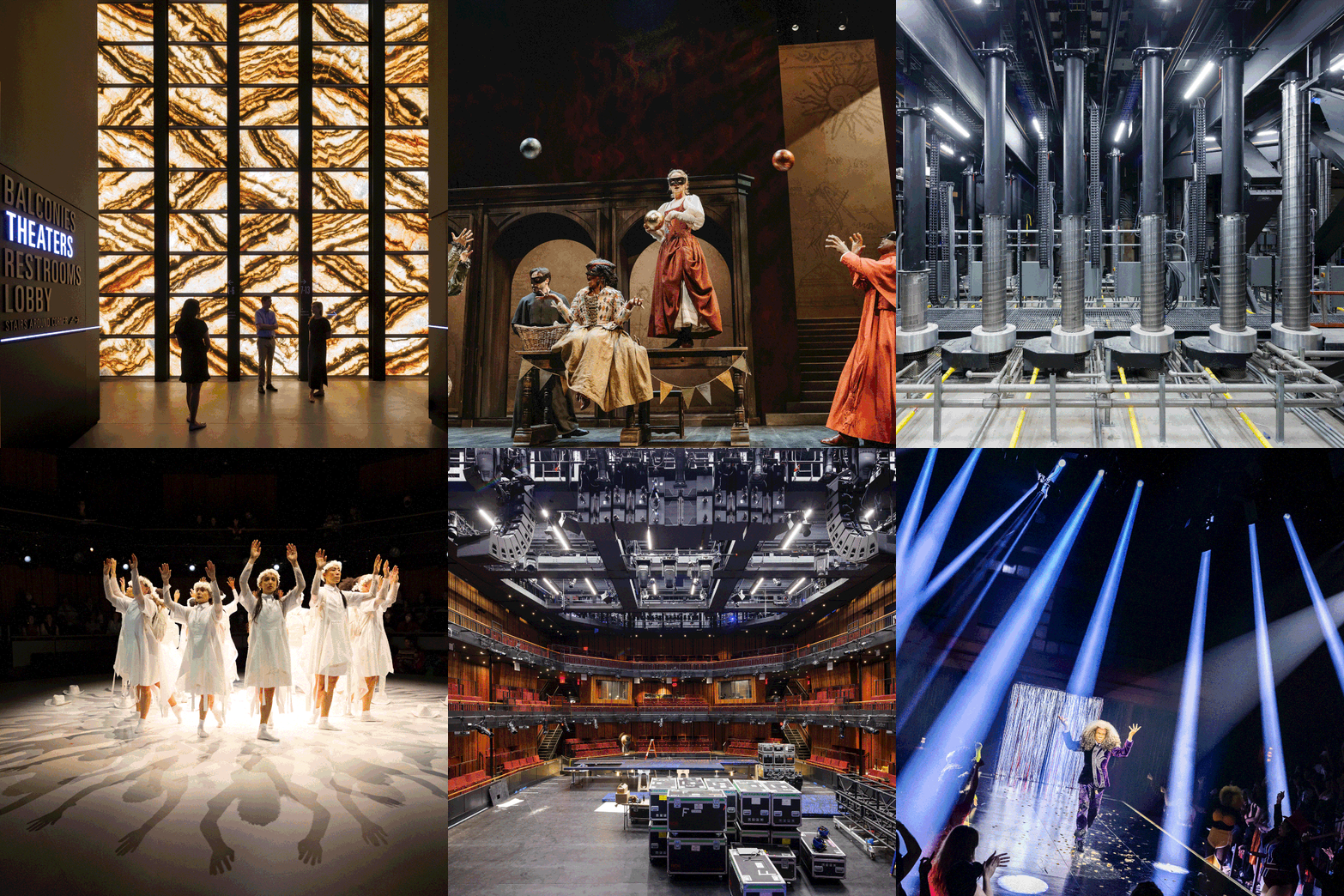

Photo: Andy Henderson, Evan Zimmerman, Iwan Baan, Matthew Murphy, Whitney Browne
Actors have broken the fourth wall since long before the term existed, turning to the audience to acknowledge the artifice of playing out private crises under public scrutiny. Today, all the walls are shifting, and so are ceilings, floors, balconies, seats, and stages. Theaters, concert halls, art galleries, and amalgams of all three have acquired springs and wheels and hinges so that they can switch configurations like costumes. Buildings now have multiple personalities.
The best equipped of these quick-change venues is the Perelman Performing Arts Center, where the architects at REX, led by Joshua Ramus, supplied a theatrical puzzle that can be rearranged at will for audiences ranging from 50 to nearly 1,000. In the nearly three years since the center opened, it has used 28 different setups, with rooms of various sizes arranged for end-stage, in-the-round, and thrust configurations, with flat floors, mezzanines, and rakes that keep renegotiating the relationship between audience and performers. The 2024 pre-Broadway production of Cats: The Jellicle Ball took place on a long runway with the audience dispersed around the space and even on the stage itself. New York’s theater critic Sara Holdren wrote about the experience of being absorbed into the show: “We are, it feels, a group of gleeful squatters — co-conspirators gathered in some old, abandoned building, thriftily decked out for new glory, passing around the cheap Champagne and crossing our fingers that the cops don’t arrive.” When the show moved to the Broadhurst Theatre on Broadway, the directors — Zhailon Levingston and PAC’s artistic head, Bill Rauch — were forced to domesticate that communal energy for a traditional proscenium arch.

The Perelman PAC’s Zuccotti theater in transition from one configuration to another.
Photo: Iwan Baan


Cats: The Jellicle Ball and Giulia: The Poison Queen of Palermo, both at the Perelman PAC. From left: Photo: Matthew Murphy and Evan ZimmermanPhoto: Andy Henderson
Cats: The Jellicle Ball and Giulia: The Poison Queen of Palermo, both at the Perelman PAC. From top: Photo: Matthew Murphy and Evan ZimmermanPhoto: An…
Cats: The Jellicle Ball and Giulia: The Poison Queen of Palermo, both at the Perelman PAC. From top: Photo: Matthew Murphy and Evan ZimmermanPhoto: Andy Henderson
The room where Cats romped has been rearranged for Jennifer Nettles’s musical Giulia: The Poison Queen of Palermo, and it now evokes the proportions of a 17th-century theater, seating just 525. But in a contemporary update, the musicians are tucked out of sight and the backstage is deep enough to accommodate bulky scenery. Fling open the upstage doors in one scene, and behind them you see the well-stocked floor-to-ceiling cabinets of a diabolical apothecary; open them in the next, and they lead to an arcaded terrace with views over the city and bay. The same festival of mass man-murder could surely be mounted elsewhere but not with the same spectacle-to-intimacy ratio.
Flexibility is also a raison d’être for the Shed, designed by Diller Scofidio + Renfro and Rockwell Associates, though the most visible transformation is the quilted canopy that rolls out to cover the plaza out front. The McCourt, as the resulting 17,000-square-foot enclosure is called, can be daylit or darkened by drapes, tricked out with lights, sound, and risers, and adapted to emulate a high-concept amusement park, a concert hall, or an arena. The floor flows into the plaza-level gallery that is currently separated from the McCourt by a retractable wall. That’s where Doug Aitken’s music-and-video installation Lightscape is now playing on seven movie screens erected on wooden frames. The audience is meant to meander as it unfolds, but the 55-minute duration risks turning that experience into a trek. A two-tiered plywood podium positioned in the center of the room stands ready for occasional live-music performances in the round, but when it’s vacant, spectators perch, lie, and drape themselves on it, turning it into a living sculpture. The sound design is impeccable, the soundtrack aptly atmospheric, and the imagery lyrical, full of parched landscapes and luscious dance. That gallery feels like the perfect frame for Aitken’s work, at once spacious and enfolding, spare and receptive to all that visual and sonic plushness. (I could have done with a beanbag chair, though.)

The Shed at Hudson Yards telescopes to form a covered plaza known as the McCourt.
Photo: Brett Beyer


From left: Luna Luna, the high-concept amusement park in the McCourt. Photo: Brian Ferry/Courtesy of Luna Luna LLCBjörk’s Cornucopia opening performance at the McCourt in 2019. Photo: Santiago Felipe/Courtesy One Little Indian/The Shed
From top: Luna Luna, the high-concept amusement park in the McCourt. Photo: Brian Ferry/Courtesy of Luna Luna LLCBjörk’s Cornucopia opening performanc…
From top: Luna Luna, the high-concept amusement park in the McCourt. Photo: Brian Ferry/Courtesy of Luna Luna LLCBjörk’s Cornucopia opening performance at the McCourt in 2019. Photo: Santiago Felipe/Courtesy One Little Indian/The Shed


Doug Aitken’s Lightscape in the Level 2 gallery of the McCourt, and Viola’s Room, performed there last fall. From left: Photo: Brian Doyle/Courtesy The Shed and 303 Gallery, New York.Photo: Marc J. Franklin
Doug Aitken’s Lightscape in the Level 2 gallery of the McCourt, and Viola’s Room, performed there last fall. From top: Photo: Brian Doyle/Courtesy The…
Doug Aitken’s Lightscape in the Level 2 gallery of the McCourt, and Viola’s Room, performed there last fall. From top: Photo: Brian Doyle/Courtesy The Shed and 303 Gallery, New York.Photo: Marc J. Franklin
There are trade-offs for transformability, and one of them is the pure pleasure in being there. A sense of welcome, comfort, and glamour are usually obligatory in new cultural buildings; here, so much focus, money, and square footage has gone into the technical capacities that there’s not much left for seducing the audience. At PAC, the ritual of proceeding from street to seat involves a disorienting journey up some battleship-gray fire stairs and down the narrow hallway that runs around the exterior of the boxlike building. The glow through the translucent stone façade prevents that journey from being downright depressing. The Shed is functional bordering on hostile: Attending a show there can feel a little Spinal Tap in Cleveland. Halls lead to escalators, more gray corridors, and ushers who shout instructions. The journey has no drama or procession, just a perpetual suspicion that this can’t be right.
In theory, all those bells, whistles, and inconveniences — inside the house, at least — add up to an elaborately designed and expensively engineered kit for supercharging the imagination. The idea is to offer a deluxe form of freedom, spaces in which creators can realize visions they haven’t had yet. Supply the tool, and artists will figure out how to use it.
Except that they already did, a long time ago. The fantasy of a cultural architecture that’s as flexible as culture itself has been kicking around for more than 100 years, and there’s something obscurely disappointing about seeing a technocratic version get put into practice. In a sense, the recent buildings are oddly backward-looking solutions to a dramaturgical problem that preoccupied the German-speaking avant-garde of the 1920s. Back then, modernist architects like Frederick Kiesler and the Bauhaus guru Walter Gropius, troubled by the gulf between actors in their bubbles of drama and audiences of passive observers, imagined theaters capable of reinventing performance itself. They aimed to build environments where practitioners and the public could intertwine, and though these projects remained unbuilt (lacking clients, money, and construction know-how), the ideas had substance. Kiesler threaded his Endless Theater with a Seussian multiplicity of ramps, platforms, and exposed elevator-stages so that, as he put it, “spectators and actors practically reach the ceiling.” Gropius devised a more disciplined machine for his Total Theater: Rotating and sinking circular platforms that could serve as stage or seating would, he believed, “rouse the spectator from his intellectual apathy, to assault and overwhelm him, coerce him into participation in the play.”

Walter Gropius’s 1927 plan for the Total Theater for director Edwin Piscator.
Photo: Harvard Art Museums/Busch-Reisinger Museum, Gift of Walter Gropius/President and Fellows of Harvard College
The modernist goals had a political dimension. The Viennese set designer Oskar Strnad saw traditional theaters as agents of social stratification with the imperial box in the center, the bourgeoisie in the parquet, and the hoi polloi in the nosebleed balcony. Strnad wanted to subvert that arrangement and instead encircle the entire audience in a ring of stagecraft. “Acting,” he mused, “may start on all sides: left and right, coming out from behind the notch-boards of the public gallery, from underneath the audience’s seats, floating by above in the circular passage, or coming out of some openings and disappearing again through others.” In his view, abolishing the proscenium would help dismantle ossified hierarchies.
A generation later, these lefty reveries yielded elaborate, ambitious designs that were steeped in the yearning for democratic, improvisational flexibility. In the 1960s, the architect Cedric Price, prompted by the guerrilla director Joan Littlewood, came up with — but never built — Fun Palace, a scaffolding that could be infinitely rejiggered to meet its users’ needs for leisure, play, and performance. In 1971, Renzo Piano and Richard Rogers conceived the Centre Pompidou in Paris as “an ever-changing framework, a Meccano kit, a climbing frame for the old and the young.” It didn’t quite work out that way: Piano and Rogers scotched the Pompidou’s movable floors so as to stay within budget, but even today the architects’ project page claims, erroneously, that the structure is “capable of change in plan, section and elevation, able to absorb the unforeseen requirements of the future.” In real life, the center is, as the architect Michael Webb once described it, “a non-operative mockup of Cedric Price’s Fun Palace.” It’s been renovated several times and is currently closed for a five-year top-to-bottom overhaul — a long hiatus for a building that was supposed to be easily tweaked but is as rigid as any stone palace.

A set of electromechanical screw-jack lifts raises and lowers the platforms at the Perelman PAC.
Photo: Iwan Baan
Still, bits and pieces of the avant-garde dream infiltrated the mainstream. Turntables — onstage, anyway — are essential at Radio City, the Metropolitan Opera, and any house that’s doing Les Misérables. Artists couldn’t shift auditorium walls, so they moved audiences instead. And defunct iIndustry supplied artistic entrepreneurs with adaptable real-estate discards, like London’s Bankside Power Station, which evolved into Herzog & de Meuron’s Tate Modern. New York revived a different sort of machine-age relic: the massive structure that the Seventh Regiment National Guard built itself on the East Side of Manhattan in 1880. The Park Avenue Armory, which metamorphosed into an arts venue in 2006, has a Drill Hall so vast, uninterrupted, and high-vaulted that it challenges artists to fill it with extravagant ideas. Ann Hamilton hung swings from the 85-foot ceiling. For Douglas Gordon and Hélène Grimaud’s tears become … streams become …, a pair of pianos rested on the surface of an immense black reflecting pool, doubling the vault in an apparently bottomless interior. Peter Sellars produced Bach’s St. Matthew Passion in a temporary evocation of Hans Scharoun’s Berlin Philharmonie, surrounding the performers with rising terraces of spectators. With astonishing and sustained nimbleness, the Armory has shown that if you really want to abolish the barriers the 20th-century modernists chafed against, all you really need is space, scaffolding, plastic sheeting, and plenty of electric cable. (Also, a ceiling-mounted lighting grid.)
The DIY-in-a-big-box approach has even been inserted, on occasion, into more venerable, theoretically nonadjustable institutions — like Carnegie Hall, for instance. Pierre Boulez, a composer of effervescent radicalism who pioneered the fusion of acoustic instruments and live electronics (and in 1967 exhorted his fellow iconoclasts to “Blow up the opera houses!”), wrote Répons for a large chamber ensemble with six percussionists and a battery of speakers distributed around a hall. For a memorable performance in 2003, Carnegie placed part of the audience on the stage and interspersed the rest with the musicians on a platform erected above the orchestra seats. The listeners stayed in place while the sound whipped around their ears, rather as Strnad had imagined a drama could do.
One art form that might seem implacably hostile to such tactics is opera, whose complex fusion of singing, stagecraft, orchestra, and costumes usually depends on generous fly space, wings, and an ample pit. But a few intrepid directors have managed to dislodge the art form from its comfort zone. Yuval Sharon, the founder of the Los Angeles–based production company the Industry, threaded a 2013 performance of Christopher Cerrone’s Invisible Cities through L.A.’s Union Station: The cast had an offsite orchestra playing in their ears and listeners with headphones were the only ones even aware that a performance was going on; everyone else barely noticed a few people in street clothes singing to themselves. At least on video, the effect is mesmerizing because it unites audiences and performers simultaneously in a secret society and at the same time erects a new, invisible wall between opera and the rest of life.

Ann Hamilton’s The event of a thread in the Park Avenue Armory’s drill hall.
Photo: James Ewing

Tears become … streams become …, also at the Armory.
Photo: James Ewing
Now, finally, the boldest experimenters can take advantage of walls that move at the touch of a button, precision lifts, rooms that shrink and expand, projected images that can be glued to moving surfaces. These Transformer-like toys seduce creators by promising the leeway to do whatever they can think of with minimal resistance. Yet I question how well a century’s worth of resourceful experimentation with inadequate but adaptable space will coexist with these high-tech containers. The revolution, now that it’s here, feels anticlimactic and overpriced.
Perhaps the most lavish example of innovation in the architecture of culture is Jean Nouvel’s new Fondation Cartier in Paris, a museum that promises to reinvent itself completely for every show. From the outside, the pleasantly cream-colored, characteristically Parisian full-block building from 1855 looks much as it did when it served as a luxury hotel and then a department store and an antique-jewelry mall. Today, though, five enormous platforms rise and sink independently, sliding up and down columns and linked by stairs that click in where they’re needed. The opening installation unfolds in a cornucopia of mezzanines, double-height caverns, walkways, and arched windows that give on to the street. A handmade submarine by Panamarenko has come to rest on the lowest floor, an immense treelike sculpture by Solange Pessoa hangs from a ceiling, and Olga de Amaral’s mosaic of red wool tiles occupies a double-height wall, like so many fascinating characters at a party clamoring for your attention. The inaugural collection exhibition follows a long, meandering, periodically thrilling itinerary of spectacle.

Pierre Boulez’s Répons at Carnegie Hall in 2003.
Photo: Steve J. Sherman 2003
Museum curators have long enjoyed the ability to move walls at will, though that almost always involves an environmentally wasteful process of construction, demolition, and starting from scratch. Nouvel’s adjustable floors turbocharge that flexibility, producing a profusion of spaces that can meet the ever-expanding demands of contemporary art. There’s a catch: Altering the installation is hardly a simple task. The first exhibition will close in August and the museum will take a two-month hiatus to reposition the floors and prepare the next show. We’ll see if it feels dramatically different.
For the Fondation Cartier in Paris, Jean Nouvel designed a set of five large moving platforms that can be raised or lowered independently. Clockwise from top left: Photo: Cyril MarcilhacyPhoto: Cyril MarcilhacyPhoto: Martin Argyroglo
For the Fondation Cartier in Paris, Jean Nouvel designed a set of five large moving platforms that can be raised or lowered independently. From top: P…
For the Fondation Cartier in Paris, Jean Nouvel designed a set of five large moving platforms that can be raised or lowered independently. From top: Photo: Cyril MarcilhacyPhoto: Cyril MarcilhacyPhoto: Martin Argyroglo
Like the Fondation Cartier, PAC and the Shed package their radicalism in deluxe architectural confections. So what’s the payoff for all that expensive versatility? In theory, the answer is freedom — but it’s a freedom dispensed by affluent and tightly managed organizations and a few well-placed control freaks. Kiesler and his heirs envisioned architecture that would make the arts more available, provisional, improvisational, democratic, and participatory, more playful and less aloof. Instead, these buildings depend on well-funded and highly professionalized top-down organizations, staffed by experts who have spent their lives deciding what the people should want. The results tend toward the vaguely experimental hodgepodge united by a certain slick, spectacular cool. What the Shed lacks in a focused sense of mission it makes up for in its allegiance to artistic brand names.
It’s hard to separate the building from the vast amount it cost to put it up —and also from the tastes of its founding artistic director, Alex Poots. An avowed interdisciplinarian matchmaker, he pairs curators and theater directors, musicians and artists, leveraging the capacities of his Hudson Yards command center with his global connections. Among the moments he cites with pride is the 2019 union of an octogenarian boy band: Steve Reich, Arvo Pärt, and Gerhard Richter. (That was then; they’re all in their 90s now.) Elitism is at the heart of the project because the building and the people who run it amplify each other’s power by bestowing a uniquely luxurious set of choices on a selected corps of creators. In the end, flexible architecture for the people could only come to fruition by undercutting its own populist rationale.


